
Like Sudoku, Kakuro is a number puzzle that is particularly popular in Japan (the name Kakuro comes from Japanese). However, it is also becoming increasingly popular in other parts of the world and is a good alternative to the more widespread Sudoku. In addition to puzzles in magazines and newspapers, there are also several Kakuro books available.
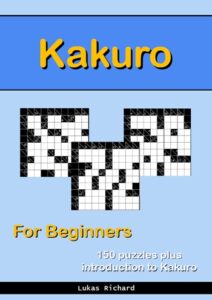
I have created four Kakuro books so far: Kakuro for Beginners, Kakuro for Advanced Players, Kakuro Strategies and Kakuro XXL.
The titles of the first three books are pretty self-explanatory. The book for beginners starts with an intro to the rules of Kakuro, and we go through a few solving strategies using an example. Then there are 150 puzzles in different sizes.
We start with Kakuro puzzles in a small 5×5 format (five rows and five columns, i.e., a maximum of four adjacent or vertical white boxes). As the book progresses, we add one row and one column at a time until we reach the 10×10 format. This is something like the standard format in Kakuro.
The book for advanced players assumes that the rules are already known. They are therefore not explained again separately. This book contains 200 Kakuro number puzzles, all in 10×10 format. Of course, both books also include all the solutions to the puzzles at the back.
In the book about the solving strategies you will find a lot of help on how to solve Kakuro puzzles.
What is Kakuro?
Kakuro was developed in the 1960s by a Canadian under the name “Cross Sums”. However, as mentioned above, the name comes from Japanese. There, the number puzzle enjoyed (and continues to enjoy) great popularity.
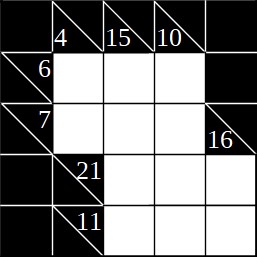
A Kakuro usually consists of black and white cells. The black cells contain the sums or are empty and serve as breaks. The numbers you are looking for are entered in the white squares. The sum is entered either to the right of the black square or below it.
There are two rules to follow:
- Only numbers from 1 to 9 may be entered in the white squares, and only one number per square.
- No digit may be repeated within a sum.
Let’s take the simple sum of 4, consisting of two summands, as an example. 2 + 2 is not allowed, as this contradicts rule 2. 4 + 0 is also prohibited, as rule 1 states that 0 is not possible. This leaves only the combination 1 and 3.
One comment