Sudoku is probably the most popular and well-known number puzzle. I have created the following Sudoku books so far:
- Sudoku for Beginners
- Sudoku for Advanced Players
- Sudoku Difficult
- Sudoku Easy to Difficult
- Sudoku Strategies
- Sudoku for the Pocket
- Sudoku X for Beginners
These are aimed at players of different levels and have varying degrees of difficulty. The first three books are aimed at beginners, advanced players, and experienced, very good players. The fourth book in the series contains a mixture of different levels, so there is something for every hobby player.
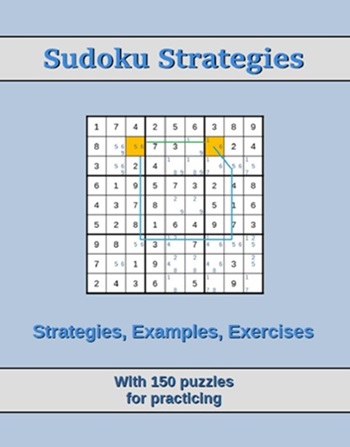
The book Sudoku Strategies presents various solving strategies for the different difficulty levels, making it suitable for all kinds of number puzzle enthusiasts. The book also contains 50 Sudoku puzzles of each of the three difficulty levels for practicing the strategies—a total of 150 puzzles.
Sudoku for the pocket says it all. Here, the format of the book is just as important as the content. The puzzles range from easy to medium difficulty. The book fits (I tried it myself) in the back pocket of a pair of jeans that aren’t too tight. This makes it particularly suitable for traveling when you don’t have a lot of space in your luggage.
About Sudoku
Even though Sudoku was invented by an American, the name comes from Japan, where it became very popular in the 1980s. Over the years and decades, however, the number puzzle has also become increasingly popular in Europe. Today, Sudoku books and magazines are an indispensable part of train station bookstores and other shops. They can also sometimes be found in newspapers—either in addition to or instead of crossword puzzles.
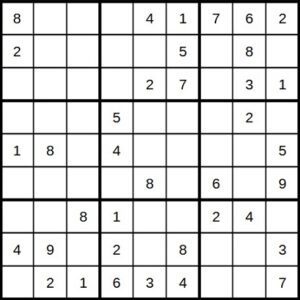
A standard Sudoku consists of 9 rows and 9 columns. The grid is also divided into 9 3×3 blocks. The aim is to enter the numbers 1 to 9 once (and only once) in each row, each column, and each block.
There are also other Sudoku variants, such as Killer Sudoku and Color Sudoku. I have also written a book on Sudoku X or Diagonal Sudoku: Sudoku X for Beginners. In addition, a normal Sudoku puzzle can also simply have a different size, for example 4×4 (quite easy) or even larger than 9×9. The books listed above are all standard Sudoku puzzles that differ only in terms of difficulty.
2 comments