This blog post was inspired by a new puzzle book I’ve published: Kakuro XXL. It contains 100 Kakuro puzzles in a 24 x 16 format (24 rows and 16 columns) and is therefore quite large.
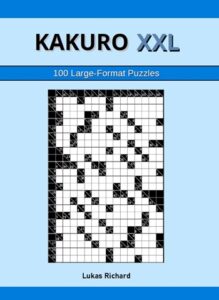
Such Kakuro puzzles may be unfamiliar to some Kakuro enthusiasts. In magazines or puzzle books, you often find Kakuro puzzles with ten rows and columns (partly due to the format), often smaller, sometimes slightly larger. Here, we’ll take a look at what to keep in mind with large Kakuro puzzles.
Why are larger Kakuro grids possible?
A Kakuro in a format larger than 10 x 10 does not violate the rules, provided the creators do it correctly.
Let’s review the Kakuro rules here:
- We can only enter numbers from 1 to 9.
- We can only enter one number per cell
- Each number (each summand) may only appear once in each sum.
It follows automatically that a sum can consist of at most nine cells, and the highest possible sum is 45 (the sum of all numbers from 1 to 9). A 10 x 10 grid is ideal here. Since the first row and the first column always contain a sum or are simply black (empty), there can be a maximum of nine white cells in a row, and a sum greater than 45 is impossible for that reason alone.
What happens if the Kakuro has more than ten rows and/or columns? Here, the developers just need to ensure that there are also a maximum of nine white cells (for entering the solutions) in a row. After no more than nine cells, these must be interrupted by a black cell. This black cell can either contain a new sum or be empty. In the latter case, it simply serves as an interruption and players can ignore it.
How can we solve large Kakuro puzzles?
Theoretically, Kakuro puzzles with thousands of rows and/or columns are possible. Of course, these wouldn’t fit on a single sheet of paper. But I’ve already seen large Kakuro puzzles in a 50 x 50 format online. In the book I mentioned above, the puzzles are exactly fitting for a single page (DIN A4) and you don’t need a magnifier to read it.
But how do you solve large Kakuro puzzles? It’s not rocket science, and the basic approach is the same as for small or standard Kakuro puzzles. The rules are exactly the same.
However, it’s naturally harder to keep track of everything here. That’s why it’s a good idea to divide the entire puzzle into different sections and work through them one by one. You can simply start with the section that looks easiest. Simple areas are usually places where a few clear sums intersect (for example, 3 and 4 or 16 and 17, each with two summands).
So large Kakuro puzzles aren’t necessarily harder to solve than small ones. Sometimes smaller Kakuro puzzles can prove particularly tricky. However, due to the size of the puzzle, solving a large Kakuro takes longer. Since you have to maintain your concentration for longer here, it’s easier to make mistakes due to loss of focus.
Otherwise, there are no real differences when it comes to solving a Kakuro based on its size. If you’re not yet familiar with solving strategies, feel free to check out my book Kakuro Strategies. The strategies presented there are suitable for puzzles of any size.