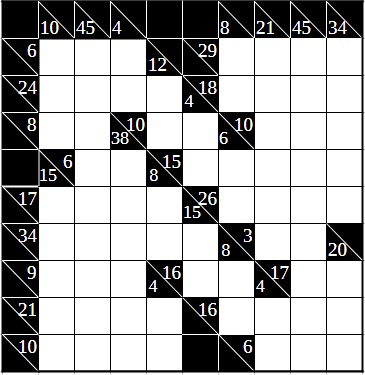
Kakuro is probably the most popular number puzzle after Sudoku. Unlike its ‘big brother’, however, it is somewhat less well known and there are fewer puzzles to be found in books or puzzle magazines. For Kakuro beginners, I will therefore describe in this article what Kakuro is, what the Kakuro rules are, and how beginners can solve simple Kakuro puzzles.
What is Kakuro?
Kakuro is a number puzzle, just like Sudoku. Due to the structure of the puzzle, some people als refer to it as a cross between Sudoku and a crossword puzzle. Instead of letters, as in a crossword puzzle, we have the enter numbers here. Kakuro has in common with Sudoku that only the numbers 1 to 9 are allowed.
The term Kakuro comes from Japanese. There, Kakuro is the second most popular number puzzle after Sudoku. Although it is sometimes presented as such, Kakuro does not originate from Japan. It was invented by Canadian Jacob E. Funk in 1966. At the time, he gave the puzzle the name Cross Sums. Why he chose this name at the beginning becomes clear when we take a closer look at Kakuro.
A Kakuro usually consists of black (or gray, blue, etc.) and white cells. The dark cells contain sums, and we have to enter numbers in the white cells ourselves.
An unsolved Kakuro might look like this, for example:
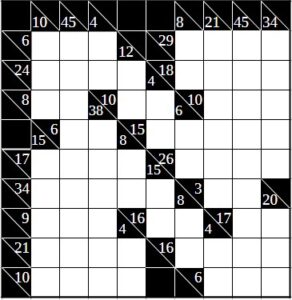
As we can see, the sum is shown in the black cells at the top right or bottom left. In some cells, there is a sum in both places. If it is at the top right, we have to enter the numbers to the right of it (up to the next black cell or the edge). However, if the sum is at the bottom left, we need to enter the numbers below it.
The sum must be made up of digits
But which numbers do we need to enter there? The numbers entered to the right of or below the sum must add up to the sum. Let’s take an example where we have the sum 10 and three white cells to the right of it. We have to enter three numbers in these white cells that add up to 10 (for example, 1, 3, and 6 or 2, 3, and 5). We also refer to these numbers as summands.
In addition, there are occasionally black cells in which no sum is placed. These simply serve as boundaries and do not require further attention.
Kakuro comes in different sizes. A standard size is a Kakuro with ten rows and ten columns (10 x 10). However, smaller (like the example below) and larger Kakuro puzzles are also possible. For larger puzzles, the developers just have to make sure that there are no more than nine white cells in a row. At that point, they must be interrupted by another black cell. Another standard size is a 16 x 16 grid.
Various Kakuro rules apply when entering these numbers, which we will now take a closer look at.
What are the Kakuro rules?
Of course, we cannot simply enter the numbers without any logic. Just like with other number puzzles, we have to follow certain rules. The Kakuro rules are as follows:
- We can only enter numbers from 1 to 9.
- We can only enter one number per cell.
- Each number (each summand) may only appear once in each sum.
Rule 2 is pretty clear, which is why the whole thing could be summarized in two rules.
Let’s look at the example from above again: The sum 10, which we have to form from three digits. The combination 0 + 3 + 7 would not be allowed because it contains 0 and therefore violates rule 1. 2 + 4 + 4 is also not allowed because the 4 appears twice, which is not permitted under the third rule. The combination 1 + 4 + 5, on the other hand, does not violate any rules and would be allowed.
Rarely, there are also puzzle books that add another rule. In these books, a combination cannot appear twice within a puzzle. For example, if there are two sums of 8 with three summands, the combination 1 + 3 + 4 cannot be entered both times. However, this is not an official Kakuro rule.
How do you solve a simple Kakuro puzzle?
There are many different solving strategies for Kakuro puzzles of varying degrees of difficulty. I have summarized some of them in my book Kakuro Strategies. In the following, I will focus on simple strategies to help beginners get started with Kakuro.
Let’s look at one of the simplest examples we can imagine:
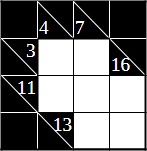
Here, it is important to pay attention to unique sums. A sum is considered unique if there is only one possible combination for it. This is the case, for example, with the number 3 with two digits, which is also the smallest possible sum. We can only form this sum with the numbers 1 and 2. Another example with two summands is the sum 17, which can only be formed with 8 and 9.
The largest unique sum (and also the largest sum in Kakuro) is 45. It is formed from all numbers from 1 to 9.
These unique sums now help us to find a starting point. It is also important to note that each white cell represents the intersection of two sums. This means that every number in a white cell is part of exactly two sums.
Intersection of two sums as a reference point
In the example above, we have two such unique sums in the upper left corner. One is the aforementioned 3 and the other is 4, which is the second smallest possible sum. This 4 can only be formed from the summands 1 and 3 (2 + 2 is not allowed according to the Kakuro rules).
The white cell at the top left is the intersection of these two sums. This cell must therefore contain a number that appears in both sums. For the sums 3 and 4, this is only 1. We must therefore enter 1 at the intersection. We can then use simple subtraction to fill in the cells to the right and below.
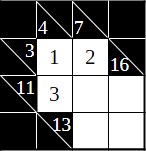
The 7 with three digits is also a unique sum. It has the summands 1, 2, and 4. We have already entered the 2 in the top of the three cells, which is why the 1 and the 4 are still missing here. This sum intersects with the sum 13 at the bottom. We can now see what would happen if we entered the two possible digits at the intersection.
If we entered 1 there, we would still have a remainder of 12 for the sum of 13 with one cell remaining. However, this is not allowed, as the Kakuro rules state that only the numbers 1 to 9 are permitted. With the 4 at the intersection, the other cell would be a 9, which is allowed. So we enter 4 at the intersection of 7 and 13 and 1 in the cell above it.
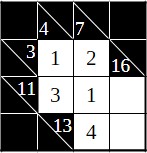
The last step is now simply to enter the other two digits by simple subtraction. This gives us the following solution:
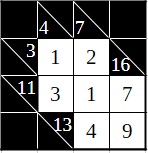
This is, of course, a very simple puzzle, and the puzzles in books or magazines will almost always be (significantly) more difficult. However, it describes quite well how beginners can approach such a Kakuro puzzle.
Summary of this Kakuro strategy for beginners
If we want to summarize the strategy used above in general terms, we can do so as follows:
- Step 1: Understand that each white box in Kakuro is the intersection of two sums, and therefore the number in that intersection must appear in both sums.
- Step 2: Search the grid for sums that look easy and/or are unique.
- Step 3: Once you have found an intersection of two unique sums, write down the individual summands for both sums (or remember them in your head).
- Step 4: If there is only one number that appears in both sums, it must be placed at the intersection.
It is also helpful to review the Kakuro rules beforehand. Knowing the rules is the first step to solving a number puzzle.
This table with all possible sums in Kakuro can be helpful. The unique sums are always highlighted in color.
Of course, even beginners can solve cells that do not consist of two unique sums. An example of this in the above example was the intersection of the sums 7 and 13. The 13 with two summands is not a unique sum. However, it was clear from logical considerations that only the 4 could be in the intersection, as the other two digits would have violated the Kakuro rules.
For significantly more solution strategies for beginners and advanced players, please take a look at my book Kakuro Strategies. It contains many examples of how to solve Kakuro puzzles and also puzzles for practicing the strategies.