Kakuro for Beginners is the first book I have written on the popular number puzzle Kakuro. It begins with an introduction to Kakuro, explaining the rules and a few basic solving strategies. This is followed by 150 Kakuro puzzles for practice. Thanks to the introduction and the small puzzles at the beginning, the book is also suitable for those who are interested in Kakuro but have no previous knowledge of it.
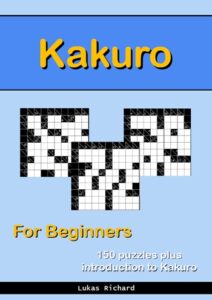
You can purchase the book for $9.99 (£7.99 / EUR 9.99 plus VAT) on Amazon*. The Kakuro grids come in different sizes. We start here with 5×5 Kakuro (i.e., 5 rows and 5 columns or a maximum of four white cells behind or below each other) and then gradually approach the (standard) 10×10 grids.
Details about Kakuro for Beginners
When you purchase this book, you will receive:
- 150 Kakuro puzzles in various sizes
- Sizes ranging from 5×5 to 10×10
- Book aimed at beginners
- All solutions included at the end of the book
- Introduction to Kakuro and explanation of the rules
- Complete example at the beginning
You can download a short excerpt from Kakuro for Beginners on this page and print it out if you wish. The file contains two puzzles in 8×8 format. This allows you to get an idea of whether the level of difficulty is suitable for you before purchasing. I am also making the introduction at the beginning of the book available for download here. Beginners who have not yet come into contact with Kakuro can familiarize themselves with the number puzzle in this way.
About Kakuro
Kakuro is a popular number puzzle similar to Sudoku. It is particularly popular in Japan, but is also becoming increasingly popular in Europe or North America. Like Sudoku, only the numbers 0 to 9 may be entered. Otherwise, however, the logic is different and it is more reminiscent of a crossword puzzle with numbers instead of words. Kakuro is often referred to as a combination of Sudoku and crossword puzzles.
Kakuro puzzles come in different sizes. The standard size is ten rows and ten columns (10 x 10). However, this is by no means the only size. Larger grids are also possible. In this case, the developers must ensure that there are no more than nine white cells next to each other without being interrupted by a black cell. Furthermore, a Kakuro does not have to be square, meaning that the number of rows and columns does not have to match. In this book, Kakuro for Beginners, we focus on square Kakuro and, above all, on the 10 x 10 size.
If you would like to learn more about the rules, you can download the first chapter of the book for free using the link above.
Other Kakuro books
In addition to Kakuro for Beginners, fans of number puzzles can also check out the book Kakuro for Advanced Players. All of the puzzles in this book are in 10×10 format and are more difficult than those in the book presented here. Furthermore, the rules are not explained again separately. Complete beginners should first take a look at this book for beginners and only then move on to the one for advanced players. There is also a book on Kakuro Strategies. This book will show you how to solve Kakuro puzzles.
If you have any suggestions, requests, or ideas for improvement, please feel free to contact us by email at info@lr-raetsel.de.
* Affiliate link: If you order a book via a link marked with an asterisk (*), I will receive a small percentage of the sales price as commission. This does not incur any additional costs for you.